Radon Test Results
Despite radon being defined as a “radioactive gas that can cause lung cancer,” test results that identify radon levels in excess of that 4.0 pCi/L threshold should not cause a buyer to walk away from the deal when mitigation systems are simple, effective solutions that quickly lower radon levels.
When I first began looking at homes in the Westchester area, the inspector we retained asked if we wanted to perform a radon test for the home in which we were interested in possibly making an offer.
“What the heck is radon?” I asked.
Here’s what the EPA says about radon:
Apparently, there’s a lot of radon in the Westchester area and, as a result, it’s regularly tested for during the home inspection process.
On average, results that are higher than 4.0 pCi/L (picoCuries of radon per liter of air) are considered unsafe.
Despite the EPA’s definition of radon as a “radioactive gas that can cause lung cancer,” test results that identify radon levels in excess of that 4.0 pCi/L threshold should not cause a buyer to walk away from the deal.
Why? Because radon mitigation systems are simple, effective solutions that quickly lower radon levels.
As a practical matter, a seller will often offer a buyer a credit to be applied at closing that covers the cost of installing a radon mitigation system. Otherwise, a seller will have a mitigation system installed and then provide a second radon test prior to closing to show that the radon results are below the 4.0 pCi/L threshold before closing occurs.
Either way, the results of a radon test should not cause a buyer to walk away from a piece of property that a buyer loves in every other aspect. Rather, a mitigation system is pretty much a basic exhaust system that usually sits in the corner of a basement and requires little maintenance but ensures the quality of the air in the home does not reach unsafe levels.

Buying A Home With Well Water
Living in the city, one turns on the tap and, voila – out comes an unlimited supply of safe, drinkable water. The idea of getting water from a well, however, that seems a lot different, doesn’t it?
It isn’t exactly new news that, due to the pandemic, some urbanites are packing up and heading for the greener pastures (literally) of the suburbs.
As a result, realtors in places like Katonah, Goldens Bridge, Somers, North Salem, Waccabuc, and Purdys are experiencing a boom in residential buying and selling.
Often, buyers looking around Katonah, Goldens Bridge, Somers, North Salem, Waccabuc, Cross River, etc., are surprised to learn that the water for many homes comes from private wells located on the property.
For someone who’s never lived outside a major metro area, it’s understandable that the idea of well water can raise concerns. Living in the city, one turns on the tap and, voila – out comes an unlimited supply of safe, drinkable water.
The idea of getting water from a well, however, that seems a lot different, doesn’t it? All of a sudden you can’t stop thinking about what it would be like to live in a house that has well water. Is that stuff even safe to drink? Am I going to have to spend money on bottled water? What if the well runs dry? Then what?
We all have concerns about new stuff. As human beings, we don’t like unfamiliar territory. (Unless we’re on vacation. For some reason, unfamiliar is fun when we’re on vacation.)
All that said, if you’re thinking about moving into a home that’s serviced by a private well, here’s some info which might help put your mind at ease.
First, private wells hardly ever run dry. And you don’t have to take my word for it. Rather, consider the economic consequences of what would happen if wells ran dry with any frequency: news of dry wells would make its way online from frustrated homeowners, which would then adversely affect property sales, which would then adversely affect local property tax revenue, which would then either result in a seriously depressed area or force towns to remedy the situation with municipal water sources, etc.
Even if, in the unlikely event a well runs dry, all hope is not lost. Rather, another well can be dug on the same property. It’s not without its costs, of course, but a dry well does not mean a property immediately loses all value.
Second, whether well water is safe to drink is a question most buyers raise – as they should. To address the concern, Westchester county passed a law in 2007 that requires property seller’s to have the well water tested by a certified lab.
Labs test the water for different . . . stuff. Rather than try to explain, here’s a screenshot of a recent test result:

One of the more important measurements is bacteria. In the image above, you can see where the lab director marked the report to identify that the water “was” of a “satisfactory sanitary quality[.]”
Sweet.
Of course, there are occasions when a test identifies bacteria in the water. This seems to happen with properties that have been vacant for some time. While I’m neither an engineer nor a water quality professional, bacteria seems to form in the well due to the lack of frequent water flow. This is commonly remedied by “shocking” the well – adding some bleach which kills the bacteria. The bacteria and bleach is then flushed out of the system by running the water in the house .
And even if the shocking process fails, a water purification system can be installed in the home that kills the bacteria as the water travels from the well to the faucets.
If you’re on the market and looking at homes that have private wells, I hope the above information helps shed light on an important area that may feel unfamiliar. Of course, where a house gets it water from and the quality of the water is something that should be taken seriously, so I’m not suggesting you should indifferently sweep aside any concerns. However, rest assured that solutions are available to homeowners should any water problems arise.
Good luck!

Cybersecurity For Small Business In New York
Despite the disparities in data security management between global financial institutions and local businesses, New York law still imposes cybersecurity obligations on even the smallest of businesses so long as private information is being stored: social security numbers, driver license information, account data, etc.
There is a TON of content online that relates to cybersecurity. To the lay person or even the sophisticated professional, cybersecurity is usually thought of as the obligation to protect personal information from exposure to computer hacks.
The depth of a business’ involvement in cybersecurity depends on different factors: the type information stored, where and how the information is maintained, the size of the organization, the industry in which it operates, etc. As a simple example, the amount of resources a public company like JP Morgan Chase dedicates to cybersecurity far exceeds how your local chiropractor handles data security.
Yet despite the disparities in data security management between global financial institutions and local businesses, New York law still imposes cybersecurity obligations on even the smallest of businesses so long as private information is being stored: social security numbers, driver license information, account data, etc.
General Business Law § 899-bb states that small businesses are in compliance if “the small business's security program contains reasonable administrative, technical and physical safeguards that are appropriate for the size and complexity of the small business, the nature and scope of the small business's activities, and the sensitivity of the personal information the small business collects from or about consumers.”
Typical legal speak, right? Awesome.
What constitutes “reasonable administrative, technical and physical safeguards” includes but is not limited to taking action such as, “identif[ying] reasonably foreseeable internal and external risks,” “detect[ing], prevent[ing] and respond[ing] to attacks or system failures,” and “assesses risks of information storage and disposal.”
How does a small business such as a local dentist identify reasonably foreseeable internal and external risks to the integrity of patients’ social security numbers? How does he or she prevent attacks or system failures?
They rely on affordable service providers to store and protect the private information. When it comes to cloud computing, sure, some providers may be more secure than others but the business has to weigh the cost of increased security against the likelihood of a breach based on the what information is being stored and the amount of information stored.
If a business does not rely on cloud storage and instead leverages local computers and external hard drives, it’s even easier to protect your data: don’t share it online and keep your computers and hard drives out of the hands of strangers. But even a scenario in which data is stored 100% locally is unlikely considering the availability and affordable costs of web-based business tools: Amazon Web Services, Dropbox, QuickBooks, Google Drive, Square, etc.
In other words, as the owner or manager of a small business, you’re not expected to be an expert in data security. However, you are expected to take measures to ensure that the systems on which you rely for data storage offer a level of security commensurate with the information on hand. So if you Google “least secure cloud storage system” and you find several tech sites who have listed cloud storage options that offer next to no data security, should a small business leverage those offerings? You know the answer to that.
On the other hand, if you choose to store private information in a well-known provider such as Microsoft’s OneDrive and you actually set up strong passwords to protect private information, then you’re probably within the boundaries of what the law considers to be “reasonable administrative, technical and physical safeguards.”

Why Did The Neurologist Call Her Patient at 11 PM? Because She Could.
For the most part, we all become products of professional environments.
For the most part, we all become products of professional environments.
I think some of the best examples of this involves politicians who campaign on changing the status quo. Yet no matter the individual intentions, the chances of one person jumping in the water ain’t gonna change the course of that iceberg no matter how hard they try.
Of course, there are always exceptions. I always think of what Manhattan was like before Rudy Giuliani was elected mayor. In 1994, I was already a few years into college, so I was old enough that the pictures in my head of midtown are vivid, as is the memory of getting robbed on West 42nd Street around nine o’clock in the evening when there were still plenty of pedestrians milling about. Not long after being voted into City Hall, and the 42nd Street of the seventies and eighties was long gone thanks mostly due to the will of one man who decided he would try to do things in a way other than they had been done before.
However, for most of us, it’s usually easier to settle into the routine of a new environment than it is to challenge the status quo, especially in the private sector where rocking the boat too much can quickly lead to an escorted walk to the door and a pat on the back from human resources. Better luck next time, pal.
Nowhere have I been more sensitive to this than since I chose the self-employment path in the legal industry. Lawyers, unlike the majority of other business professionals with whom I’ve worked, are the least likely individuals to respond to informal inquiries. Getting a return call from another attorney within two to three days of leaving a voicemail is the norm rather than the exception. I’ve even referred clients to colleagues who never bothered to call or email to even acknowledge the referral, let alone express anything within driving distance of gratitude.
I have to admit that, working in such an environment, there have been times when I’d receive an email from another attorney and think, “You want a reply? Write a letter.” Replying on a Monday to a voicemail received at three o’clock on a Thursday seemed acceptable. Or ignoring any communication from an adversary outside of papers filed with the court started to almost feel . . . normal.
But it’s not normal. Far from it, actually. It’s discourteous, to say the least. And it’s that lack of courtesy that served as motivation when I first began to practice. I clearly remember thinking, “I’ll beat the competition with better client service alone.”
Whether I’m beating the competition or not, that remains to be seen because this thing I’m doing is more like a marathon rather than a sprint. However, what will never change is that I don’t want to be the attorney whose actions are defined by the behavior of the legal field in general. It’s just too easy to do better.
With some exceptions, my phone is almost always with me. (It’s always a joke when you’re talking to someone who, despite glancing at his or her phone every nine seconds, tells you they didn’t get the email you sent the other day.) Sure, I put my phone down near six every evening to spend time with my family, but when the fun starts to die down near eight or nine p.m., take a guess what I’m doing? Yeah, I’m checking my work email and I’m not ashamed to admit it. I don’t punch a clock at nine a.m. and then head out the door without a care in the world near five p.m.
Why not? Because doing so doesn’t require more than a few minutes to address any inquiries that have since arrived. There’s a lot to be said for not keeping people waiting, so a small amount of effort goes a long way.
Years ago, one of my in-laws relayed an anecdote about a neurologist leaving her a voicemail close to eleven p.m. so she had recent test results that had come back normal.
99.4% of doctors, a statistic I just fabricated based on my own experiences, are not going to call patients after business hours, but this particular neurologist, for whatever reason, decided he would break from the norm.
Do you think his patients appreciate his extra effort? Would you?

New Opportunities Are Rising From The Covid-19 Ashes
The first step in identifying whether spending money to form a legal entity is understanding the purpose of doing so. Overall, legal entities, whether corporations, LLCs, limited partnerships, etc., serve multiple purposes, the most common being (1) protecting the individuals who run the business from personal liability, (2) minimizing tax liabilities, and (3) making sure you’re set up to raise capital, if needed.
In terms of business, the coronavirus giveth, and the coronavirus definitely taketh away.
For any service-based business that was deemed non-essential, Covid-19 tooketh away, and I mean big time. Government-mandated closings resulted in government-mandated total loss of income albeit with some well-intentioned but logistically-challenged federal rescue measures: EIDL and PPP.
Conversely, Covid-19 resulted in a boom for some businesses that most of us likely did not see coming: toilet paper producers, summer vacation rentals (due to summer camps closing), increase in demand for home pools, and the rise in sales and rentals of RVs, to name a few.
The point, I think, is that despite deflating stories in the news, e.g., unemployment rates, bankruptcies, federal bailouts, etc., new and unexpected opportunities will always rise from the ashes.
Individuals starting a new business will no doubt research whether they should invest in forming a legal entity such as an LLC or corporation. The answer to that question is similar to the answer to most business and legal-related questions.
“It depends.”
The first step in identifying whether spending money to form a legal entity is understanding the purpose of doing so. Overall, legal entities, whether corporations, LLCs, limited partnerships, etc., serve multiple purposes, the most common being (1) protecting the individuals who run the business from personal liability, (2) minimizing tax liabilities, and (3) making sure you’re set up to raise capital, if needed.
LIABILITY
There are two key criteria to consider when it relates to an owner’s personal liability.
First, does the cost of forming a legal entity outweigh the potential liability a business owner and its partners may face in the event of legal action on behalf of clients or creditors?
Second, can the business can buy enough insurance that would protect the owners from that same liability?
With the majority of the country sheltered-in-place, coupled with astronomical unemployment rates, small service businesses are on the rise. For the sake of argument, let’s compare a swimming pool service to a business consultant working with corporate clients.
Applying the questions above, what are the potential costs of a pool service professional’s potential negligence compared to the consultant? Assuming both are insured, is the coverage sufficient to cover potential worse-case-scenario claims?
Even if the pool company services high-end commercial clients like hotels and resorts, could potential negligence incurring damages that would exceed a $1,000,000 liability policy? If the pool company’s insurance is likely to cover the worse-case-scenario claims, then the owner is unlikely to face personal liability for his business and, therefore, the cost of forming a legal entity may be unnecessary.
Conversely, the business consultant providing counsel to larger businesses may have more of a reason to form a legal entity designed to provide protection against personal liability. First, the consultant may not even think to investigate commercial liability insurance because his entry and overhead costs are so low. It may simply escape her mind when getting the business off the ground.
Moreover, she may even default to first thinking of forming a legal entity due to the nature of the services provided. Whereas a mishap by the pool company will likely lead to damages that are easily calculated based on the cost of repairs, identifying the cost of damages in the corporate world can be a more slippery task considering projects have multiple layers in terms of individuals, teams, products, policies, procedures, etc.
Accordingly, because it probably makes sense for the pool company to pay the insurance premiums year over year considering the nature of the business (and other factors beyond the scope of this writing), forming a legal entity may be unnecessary. On the other hand, it likely makes a lot more sense for the business consultant to incur the one time cost compared to ongoing insurance premiums.
TAX CONSEQUENCES
How profits are taxed is another major factor when considering whether a legal entity is needed for a business. The first thing to do? Talk to your accountant. Seriously, call a CPA now. Explain your business idea and get his or her opinion regarding what legal entity may be best suited for tax purposes.
Otherwise, in brief, entities such as partnerships and LLCs are considered pass-through or flow-through entities, meaning that the businesses profits pass down to the owner’s individual tax return and are taxed accordingly.
Conversely, subchapter C corporations experience double taxation in that income is taxed at the entity level and then taxed again when dividends are distributed to shareholders. However, note that profit paid as salaries is classified separately and not subject to double taxation.
RAISING MONEY
This is important and it’s not often discussed online.
If a business is unlikely to have to raise money and potential liabilities can be covered by insurance, then the cost of forming a corporation, especially a subchapter C corporation, is likely unnecessary. There are tax considerations, as well, but we’ll leave that out of it for now.
Even if a small business needs money to cover costs such as new equipment, short-term cashflow gaps, etc., then credit or small business loans may suffice.
However, if the business contemplates the kind of growth that requires raising money from venture capitalists, then a C corporation may be the way to go because some VCs are prohibited from investing in C corporations for different reasons, i.e., tax exemptions of some partners involved in VCs
That said, if the vision for your business is to raise capital to help get the motors running, then the default LLC thinking may not be for you.
Overall, the thinking here represents the tip of the iceberg when it comes to forming a legal entity for a new or existing business. If you want to discuss in greater detail, let us know.

Covid-19 Business Survival Outlook
I encourage anyone running a business to hold a few basic ideas in mind to keep the bigger pictures in perspective.
I was reading an article on Bloomberg.com in which the author was making some rather confident predictions about the economy.
I don’t think so.
While most businesses are very much hoping that the current economic situation will soon improve (which seems likely once businesses begin re-opening upon lifting of state-level restrictions), no one knows for sure what is going to happen next week, let alone next month, when it comes to the national economy, Covid-19 infection rates, vaccine development, etc.
If that sounds pessimistic, the intention is the opposite. Because no one has the winning lottery numbers, no one actually knows what is going to happen with our economy. The point being, there is a lot of information being broadcast about what small and medium businesses should be doing during the current crisis. Some is helpful, some is not. However, I encourage anyone running a business to hold a few basic ideas in mind to keep the bigger pictures in perspective.
Be Wary Of Authors And Their Crystal Balls
Try to filter out as much “noise” as possible. Any time you read or hear conclusions about what’s going to happen, your antenna should go up. And I’m not talking about the local broadcaster informing viewers about alternate-side of the street parking for tomorrow. Rather, I’m talking about conclusions like the following sourced from a post on Bloomberg.com: “The U.S. economy post-Covid-19 will look a lot like the one that struggled to recover from the 2008-09 financial crisis - only in some ways worse. Growth will be disappointingly tepid after an initial rebound and, for a time at least, inflation dangerously lower and unemployment heartbreakingly higher than they were back then.”
I hate to pick on the guy, but how does he know what’s going to happen?
Survival Is All But Guaranteed
Above all else, try to keep in mind that the current circumstances are not “the end,” so to speak. If you take a glance in the rearview mirror, there is several thousand years of agricultural, industrial, societal, cultural, and technological progress behind us, albeit with the occasional bump in the road. With that in mind, it is extremely likely that our civilization will continue progressing despite the current pandemic.
That said, you may be sitting there thinking, “Thanks so much! Waxing poetic doesn’t exactly put money in the bank, does it?”
I don’t disagree with you. However, if I started this section with, “Try to remain calm,” we could have chalked that up to me telling you something you already know. Further, has anyone in the history of remaining calm ever remained calm as a result of a lawyer’s suggestion? Probably not.
But if you think about business over the past hundred years or so and, if you think about your professional life overall, some sense of calm may follow because (a) business has made it this far and, more importantly, (b) you have made it this far which means, (c) your business will likely continue to make it despite the pandemic.
Dive Deep
It is often said that the true mark of a champion is not how she performs while at the top of her respective game but how well she performs when the going gets tough. I believe the same can be said of most businesses.
As always, there are exceptions: how does the three-chair barbershop survive when New York State has mandated that the doors close for as long as they have? In that scenario, I’m unsure how much strategic creativity will save the business. Thankfully, the government made available the Paycheck Protection Program safety net to help avoid even deeper economic percussions.
However, for those businesses that provide products or services, those that can pivot are those most likely to not just survive, but to continue managing some level of cash flow which helps not just the organizations, but the economy overall.
But what does “pivoting” mean? It means examining how the business has been run so far and what changes can be implemented yesterday in the hopes of keeping the business going, even if it means producing a modified product or service to an entirely new target market.
Note, I do not write this as a marketing or business development expert, so I don’t make the above statement as if I’m sitting in a position of authority. Rather, my purpose is to encourage past, current, and future business clients to brainstorm opportunities that may arise from the challenges imposed on all of us due to the pandemic. Other business are doing it. So can you.
Money Is Cheap
A college professor explained interest as rent on money and I think that was accurate. If cash flow is getting down to pretty much the last drop, this may be a good time to borrow some coin.
Because interest can adversely impact profit, it’s often a knee-jerk reaction to decide against borrowing, even in the face of low interest rates. It’s worthwhile, however, to calculate the amount of interest that the business would likely pay on an amount borrowed. When interests rates are as low as they are now, the actual amount of interest in total dollars may seem a lot more palatable compared to going out of business.
And, again, try to keep bigger pictures in mind. Growth and sustainability for all businesses are almost impossible without capital. Try to avoid allowing interest to cause your business to stick it’s head in the sand hoping for sunnier days.
Creditors Galore
It’s probably a solid guess that the majority of businesses currently lack the cash flow to satisfy all of their bills. With all of New York State having been on pause for sixty days, it’s hard to imagine how many organizations, other than grocery stores and face mask producers, who have had enough steady cash flow to keep current on their liabilities.
In other words, operations that lack the ability to pay bills are the majority rather than the minority, so if your business fits in that category, you are by no means alone no matter what your creditors may tell you.
And speaking of creditors, two things. Any creditor who has the audacity to threaten legal action for past due invoices is pretty much full of it. Courts in New York have been all but closed to all “non-essential” proceedings for two months. Once the Courts re-open, it’s going to take a long time before new proceedings find their way onto any judge’s calendar, especially as it relates to creditors taking action based on breach of contract. And even if a creditor does decide to take that route, it’s hard to imagine judges finding sympathy for creditors demanding their money despite the pandemic.
At the same time, though, I would advise against ignoring creditors completely. Rather, I would encourage every business that it probably makes a lot of sense to simply explain to your creditors that (a) cash flow is non-existent due to (b) the current economic climate of which every creditor is aware, but (c) you plan on paying your bills as soon as you can.
We Are Not All In This Together
You’ve probably heard or seen that kind of language a lot in the past few months. What in the world it’s supposed to mean, I have no idea. If I told you, “We’re all in this together,” you could easily reply, “Isn’t business ‘dog eat dog?’” Or, “Does that mean you’re going to pay my bills?”
See what I’m saying? Of course, friends and colleagues will help as best possible, but I think it was Brian Tracy who said, “The true test of leadership is how you function in a crisis.” Same idea as what champions do when the chips are down, and I think it’s relevant for businesses in New York.
Keep fighting the good fight.

Check Your Insurance Policy For Coverage Due To The Covid-19 Pandemic
If you’re a New York business owner who’s been forced to close as a result of the coronavirus pandemic and you carry commercial business insurance [find good link], this would be a very good time to carefully read your policy.
If you’re a New York business owner who’s been forced to close as a result of the coronavirus pandemic and you carry commercial business insurance, this would be a very good time to carefully read your policy. In particular, you’re going to want to have a look at what kind of coverage you have for specific types of loss, including “physical loss of or damage to” your business property and anything related to “civil authority.”
For example, some businesses around the country have submitted claims for loss of income based on “physical loss of or damage to” physical property. Specifically, businesses are claiming that, because the pandemic has forced them to close their doors, they have suffered “physical loss” of the use of their business location.
News reports are identifying that insurers are reflexively denying such claims based on the grounds that the “physical loss” has to be the result of physical damage. While our firm doesn’t litigate insurance claims, we would recommend getting in touch in the event your claim is rejected. In that event, we could make referrals to commercial litigators who are helping businesses like yours more aggressively assert their claims.
Before you make a claim, however, it’s important to also check your policy for applicable exclusions, meaning is there any language in your policy that excludes benefits associated with pandemics, viruses, etc.
Another avenue a business may be able to take includes claims based on an order of civil authority. This is particularly relevant here in New York where the governor has issued an order mandating all non-essential business to close. Therefore, if your policy states it will cover losses due to orders of civil authority, now could be a very good time to make a claim.
There’s a great article on the New York State Bar Association’s web site that outlines the different claims a business could potentially pursue when making a claim for loss of business income as a result of the pandemic.
The key takeaways when it comes to making claims for loss of business income as a result of the COVID-19 pandemic?
If your policy provides for the types of coverage discussed above, submit the claim. The worst possible outcome is that your claim is denied but until you do that, you won’t know for sure.
And if you contact your insurance broker who then advises that your policy doesn’t cover a claim for losses due to the pandemic, it may be worthwhile to make the claim anyway.

Guardianship Legal Procedure
When it comes to guardianship proceedings, the majority of clients come to the table with the best of intentions: someone they know has become unable to take care of their personal and financial affairs and, without help, the circumstances will go from bad to worse.
The steps involved in any legal proceeding can seem confusing. Even practicing attorneys can end up scratching their heads when faced with counterintuitive court-mandated procedures that feel like they fly in the face of common sense.
When it comes to guardianship proceedings, the majority of clients come to the table with the best of intentions: someone they know has become unable to take care of their personal and financial affairs and, without help, the circumstances will go from bad to worse.
Even worse, circumstances arise where a friend or family member is financially abusing a person who has lost the ability to recognize that they’re being ripped off. When that happens, the people trying to help want to make sure that the wrongdoer is held accountable.
While such intentions are admirable, holding someone accountable for suspected financial elder abuse puts the cart before the horse.
In a guardianship proceeding, the first step is to ask the court to appoint a guardian for the alleged incapacitated person. If the court appoints a guardian, it then becomes the responsibility of the guardian to investigate the financial abuse and take action if the guardian finds that doing so is in the best interests of the incapacitated person.
For example, let’s say Matilda lives in Queens with her twenty-year-old grandson, Josh. While the rest of the family understands that Josh is not exactly making the most of his life by way of drug abuse, Matilda is blind to all that and can’t help but think the most of her grandson.
However, Matilda has been suffering from memory loss the past year and trusts that Josh, to whom she gave her ATM card so he could buy groceries, is applying her $1,500 monthly social security check for nothing other than rent, milk, and bread.
When Josh’s sister Stephanie visits her grandmother while Josh is out, she spots one of Matilda’s bank statements on the kitchen table. She can’t help but notice all of the recent $200.00 withdrawals that were made from ATMs in the middle of the night around downtown Manhattan. Realizing her clubbing days are well behind her grandmother, Stephanie concludes that Josh has been funding his lifestyle with their grandmother’s money, so she contacts The Donaldson Law Firm to inquire about guardianship.
“And most of all,” Stephanie tells us during the consultation, “I want to make sure my brother Josh has to give back all of the money he’s stolen from my grandmother.”
Stephanie has every right to be upset. The first step, though, is to prove to the court that the appointment of a guardian is necessary because Matilda is incapacitated due to her inability to manage her financial affairs.
If successful and the court appoints a guardian (and Stephanie does not have to be the guardian – she can ask the court to appoint an independent law guardian), the obligation to investigate the financial abuse falls on the guardian.
If interested in discussing a guardianship case you’d like to start, please contact our offices for more information.
Stephen Donaldson, Esq.

How Do You Know What You Know?
How you know what you know is extremely important in all legal matters, but it’s even more important when it comes to litigation, especially Article 81 guardianship proceedings.
A question that attorneys constantly throw at their clients is, “How do you know that?”
How you know what you know is extremely important in all legal matters, but it’s even more important when it comes to litigation, especially Article 81 guardianship proceedings.
If you’re thinking about starting a guardianship proceeding for someone you know, doing so is going to require submitting a petition that includes facts the Court is going to need in order to determine whether he or she should appoint a guardian.
And because every person who starts a guardianship proceeding is required to give testimony in Court regarding those facts, it’s important that most of the facts are based on personal knowledge: what you know based on what you’ve personally seen, heard, and read.
Conversely, the kind of information to avoid is what we lawyers call “hearsay.” No doubt you know about hearsay if you’ve ever watched more than about sixty seconds of Law & Order. What hearsay means, though, are facts or information that you think you know but you don’t really know to be true because you lack first-hand personal knowledge.
Here’s an example:
“Is Mary in the hospital?” Jane asked John.
“Yes,” John replied, “she was admitted to the hospital yesterday.”
If Jane were to testify that Mary is in the hospital, that would be hearsay because Jane has neither seen Mary in the hospital herself nor has Mary told Jane directly about her hospital admission. She only knows about Mary’s hospital admission from John so her knowledge is not first-hand.
In any legal proceeding, including guardianships, second-hand information is inadmissible. There are exceptions, of course, but the general rule is that hearsay cannot be offered as evidence.
The same hearsay rule applies to documents. Here’s an example of a common exchange our office holds with clients during guardianship consultations:
“My brother has been stealing from our mother,” Jill Client says.
“How do you know that?” the attorney asks. (There’s that question again.)
“Well, my sister has access to my mother’s accounts online. She told me that there are a lot of ATM withdrawals on my mother’s accounts but she never uses ATMs. It has to be my brother because my mother lives with him.”
“Did you see the statements yourself?”
“No, like I said, my sister saw them.”
While there’s no reason for Jill Client to not believe her sister, she cannot testify about the ATM withdrawals during a guardianship hearing because it’s hearsay – Jill herself has not seen the statements so what she knows of them is based on second-hand knowledge. In that situation, the best thing to do is for Jill to get copies of the statements herself to be used during the hearing to avoid the hearsay objection.
While it may sound simple, it’s usually a tough idea for clients to get behind because so much information we deal with in our personal and professional lives is hearsay. Joe said this. Mary saw that. It goes on and on. And because we don’t spend our lives in courtrooms where judges are quick to exclude hearsay, there’s no reason for us to sift through what’s hearsay and what isn’t.
The point is that, when considering whether you should start a guardianship proceeding for a friend or family member, doing so is going to require providing information that shows the person is unable to manage his or her day-to-day personal affairs and/or their financial matters. So when you think about the facts, be sure to ask yourself, “How do I know that?” Is what you know to be true based on your own personal observations or what someone else has told you?
The more personal knowledge you have regarding a person’s inability to manage his or er day-to-day personal affairs and/or their financial matter, the more likely you are to succeed in Court.

The Legal Standard in Article 81 Guardianship Cases
The main reason behind hiring a guardianship attorney is because the attorney knows exactly what evidence the Court is going to require in order to succeed. The attorney’s job is to guide a client by sorting through all of the available information to determine what is relevant and, therefore, what is going to satisfy the legal standard the court will apply during the hearing.
As an attorney who has been involved in hundreds of guardianship proceedings, I speak with a lot of people who want to know how they can apply for guardianship of a friend or family member.
Rightfully so, most of the people who call with questions about guardianship proceedings are unsure how the overall legal process works and, as a result, callers are unsure how to start the conversation. They’re unsure what information is relevant. That’s to be expected because, otherwise, they wouldn’t need an attorney. Rather, they could draft the necessary court documents themselves in order to get the proceeding started.
Which brings me to the point: the main reason behind hiring a guardianship attorney is because the attorney knows exactly what evidence the Court is going to require in order to succeed. The attorney’s job is to guide a client by sorting through all of the available information to determine what is relevant and, therefore, what is going to satisfy the legal standard the court will apply during the hearing.
In other words, the legal standard is the frame into which the attorney is responsible for positioning only those facts that are relevant.
The following is a paraphrased version of the legal standard for a guardianship proceeding:
The court may appoint a guardian if the appointment is necessary to provide for the personal needs of that person, including food, clothing, shelter, health care, or safety and/or to manage the property and financial affairs of that person, and that the person agrees to the appointment, or that the person is incapacitated.
So there are really two parts to the above standard. First, the court may appoint a guardian if it appears to the court that the person is incapable of handling his or her day to day affairs. Second, the person must either agree to the appointment of a guardian or, if not, then the court has to find that the person is incapacitated.
As it relates to a guardianship proceeding, the law spells out what “incapacity” means:
Someone is incapacitated if that a person is likely to suffer harm because the person is unable to provide for personal needs and/or property management and the person cannot adequately understand and appreciate the nature and consequences of such inability.
That was kind of a mouthful, so let’s break down the entire standard into smaller, bite-size pieces:
1. The court may appoint a guardian-
2. If the appoint is necessary-
3. To provide for someone’s personal needs with personal needs meaning food, clothing, shelter, health care, etc.-
4. Or someone’s financial affairs-
5. And the person either agrees to the appointment of a guardian-
6. Or the person is incapacitated-
a. Incapacity is defined as the likelihood that the person will suffer harm because he or she is unable to take care of their personal needs or financial affairs and they don’t understand the nature and consequences that they’re unable to do so.
If you call The Donaldson Law Firm and want to talk about a guardianship proceeding, we’re going to ask questions involving answers that address the legal standard because, when you end up in court to prove your case, the only way the judge is going to appoint a guardian is if facts are presented that address the legal standard.
For example, let’s say Joe calls about his mother Mary. Joe says he thinks Mary needs a guardian. Here are some of the questions that we’ll ask Joe:
a) How old is Mary? Where does Mary live now? Does Mary live with anyone or does she live alone?
b) Can Mary get up out of bed by herself? Can she bathe unassisted? Can she cook? Can she perform simple household chores?
c) If you gave Mary a bill, would she know to pay it? Can write a check? Has she been paying her bills on time?
d) Is Mary suffering from memory loss that prevents her from realizing she can no longer handle her daily affairs?
Coming full circle, there is probably a lot of information you can share with an attorney when you’re thinking about starting a guardianship proceeding. However, the most important information that you need to give your attorney are those facts and allegations that identify whether the person is unable to manage their daily affairs and that they fail to appreciate they can no longer do so.
I hope that was helpful.
Stephen Donaldson, Esq.

Your Time Is Just As Valuable As Mine
When speaking with clients and friends alike, it’s a common complaint that professionals like doctors and lawyers seem to think their time is more valuable than the people to whom they provide services.
When speaking with clients and friends alike, it’s a common complaint that professionals like doctors and lawyers seem to think their time is more valuable than the people to whom they provide services.
Doesn’t that drive you nuts? When someone thinks they’re more important than you because they have a piece of paper on the wall that says they went to medical or law school? When some dermatologist keeps you waiting for nineteen minutes in his exam room because he has “other patients” he’s helping while he should be helping you?
It makes zero sense to me. Just because I went to law school and I provide a specialized service doesn’t mean my time is any more valuable than my clients’ time, which is exactly why I keep my calendar wide open when I have a client appointment. As soon as I hear the receptionist announce my visitors have arrived, I stop what I’m doing and head straight to the front of the office with a handshake and a smile.
Why? Because it’s easy to do, it doesn’t cost me anything, I think it makes a good first, second, or third impression, and it doesn’t make sense not to do it.
What I never do is what other attorneys do, especially those whom I’ve hired for my own legal needs: tell clients that I’m not going to have the time to get to their case because I have other things to do. Believe it or not, I’ve actually had colleagues who I’ve hired to help me with basic transactional matters say that to me: “I’m not going to have the time to get to it today, blah, blah, blah.”
There are many reasons why some attorneys will never rise above the realm of solo practice and they will never have an empire of a law firm that they can one day sell if they want to retire. One of those reasons is telling clients that they have other client matters they have to handle and/or they’re too busy to get to it right away.
Can you imagine placing an order with Amazon.com and then receiving an email that stated, “While we’d love to fulfill your order right away, we have a lot of other orders that came in before yours, so we’re going to ship your order as soon as we ship the other ten million orders that came in before your order. This could take a few weeks. Please be patient.”
Are you kidding me? Even if an attorney has other matters he or she has to handle and he or she is not going to have the time to immediately work on your case, the last thing he or she should do is to tell you that he or she is too busy for your case. Instead, he or she should explain, in so many words, “Your case is a priority. Before I move forward, though, I want to make sure I’ve got all of my legal research ducks in a row and spend a few more minutes making sure there isn’t anything I’m possibly overlooking. That said, you should hear from me within a day or so. If anything comes up between now and then, don’t hesitate to contact me, preferably by email. But most importantly, I wanted to make sure that you knew that I haven’t forgotten about you and I’ll be working hard on your case.”
It seems so simple but the attorneys who know nothing about customer service, they take a retainer, put the case on the back-burner because the manner in which they conduct their practice is nowhere within driving distance of efficient, and then they leave a client in the dark for days, if not weeks. When the client eventually calls to find out what’s going on, the response is, “I’m not going to have the time to get to it today.”
(I even had a contractor in my home recently and, when I passed by the room in which his helper was working, I heard the guy complain, “I wanna go home!” If going home to hang out is more important than doing the job, then that is one contractor who I’m never going to work with again.)
There’s no place for that any more, especially not in the digital age of online reviews and ratings, and especially when almost every neighborhood has more than one doctor or lawyer who can address a patient’s or client’s needs. Of course, not being a doctor myself, I can’t speak to how a doctor should run a practice, but when it comes to lawyers, clients should ask upfront, “When will I hear from you after I give you all of this money to handle this problem for me? Can I email you when I have a question? How long does it take you to respond? Will I hear from you or am I going to be bounced around from one legal assistant to another?”
Every professional in the world should do everything in their power to make a positive impression on their clients. And it doesn’t take a genius to figure out what that involves. If you’re a lawyer, Google “most common client complaints,” and make sure you never do any of the things on that list.

Got Hit? Get Information
A few years ago, I was riding south along the bike path on the West side in Manhattan when I came across a fallen rider. The poor guy was laid out along the cobblestone entrance near the Circle Line, clutching his elbow, obviously in a goodish amount of pain. I came to a stop and asked what happened. A second guy said, “It was my fault. I cut in front of him by accident.”
A few years ago, I was riding south along the bike path on the West side in Manhattan when I came across a fallen rider. The poor guy was laid out along the cobblestone entrance near the Circle Line, clutching his elbow, obviously in a goodish amount of pain. I came to a stop and asked what happened. A second guy said, “It was my fault. I cut in front of him by accident.”
Hearing someone take responsibility was admirable. I wish more people were like that but most people aren’t so quick to take responsibility for doing whatever he or she wasn’t supposed to do, especially when it results in an accident.
The fact is, when it comes to walking, riding, or driving, most people are unable to follow the underlying basic rule: look where you’re going. Drivers text while driving. Tourists ride Citibikes and look everywhere but the road in front of them. Club cyclists ride three across and are too busy chatting to pay attention to the road.
And then there are pedestrians. If I’ve said it once, I’ve said it a hundred times - pedestrians do not have the right of way. If you’re riding your bike and a pedestrian crosses against the light and you hit that pedestrian, YOU had the right of way and that pedestrian could be responsible for your injuries.
But unlike the cyclist I mentioned above who admitted he was wrong, most people are not going to be so forthcoming. Most people are going to argue it was you who did something wrong. They will do whatever they can to avoid being put in a position where they have to man up and take some responsibility.
That’s not your job, though. As the New York Bike Accident Lawyer, holding someone responsible for your injuries is MY job. Your job is simply to get information. Your job is to get the name and address of the person who was involved in the accident with you. Your job is to call the police so they can make a report of what happened. And when the police arrive, don’t worry about trying your case right then and there. Your job is to simply tell the police what happened as accurately as possible. Remember, police reports can be changed after the fact if they get it wrong the first time.
So what’s your job if you get into a bicycle accident? COLLECTING INFORMATION. Call the police. Get the names of witnesses. Do NOT hesitate to ask for someone’s name and number if they saw the accident. Use your phone to take pictures of the accident site and damages.
Some people will not let you take a picture of their ID cards and that’s fine. You want names and addresses and phone numbers, if you can get them.
If someone doesn’t want to share their info with you, fine. Don’t start a fight. But do call the police and tell them as much.
And when you’re done with all that, call Stephen Donaldson, Esq., the New York Bike Accident Attorney, at 516.385.2061 or email us at steve@nypractice.com.

What "Share The Road" Doesn't Mean
The problem with SHARE THE ROAD is that it can mean different things to different people. To an uninformed driver, SHARE THE ROAD might mean a cyclist has to ride on the sidewalk when there's no bike lane. And to an unreasonable cyclist, SHARE THE ROAD might mean riding in the dedicated bike lane is entirely optional.
It's common to see yellow or orange street signs that read SHARE THE ROAD.
The problem with SHARE THE ROAD is that it can mean different things to different people. To an uninformed driver, SHARE THE ROAD might mean a cyclist has to ride on the sidewalk when there's no bike lane. And to an unreasonable cyclist, SHARE THE ROAD might mean riding in the dedicated bike lane is entirely optional.
Neither is accurate. While SHARE THE ROAD may be open to interpretation, the laws that state the rules of the road for cyclists are not so loosey-goosey, so let's talk about what rights and obligations are imposed upon us while we're out riding.
CYCLISTS MUST OBEY THE SAME TRAFFIC LAWS AS MOTOR VEHICLES
Check out section 1231 of the NY Vehicle and Traffic law. This is the section that basically says cyclists have to follow all the same traffic rules as motor vehicles. In other words, we don't get to blow red lights and STOP signs because we're riding bicycles. But we all knew this already, right?
STAY TO THE RIGHT & RIDE SINGLE FILE WHILE BEING PASSED BY MOTOR VEHICLES
Section 1234 is a bit of a doozy because it lumps inline skaters in with bicyclists, but here's the basic gist:
When riding on roads, always stay to the right "to prevent undue interference with the flow of traffic" unless the cyclist is preparing to make a left turn or needs to avoid conditions on the side of the road that "would make it unsafe to continue along near the right-hand curb or edge."
Cyclists are permitted to ride more than two abreast ONLY while riding on a shoulder or bike lane where there's enough room to do so. Otherwise, cyclists can only ride two abreast while staying to the right UNLESS being overtaken by motor vehicles from behind, at which time riding single file is required.
In other words, if there's enough room on the shoulder or bike lane to ride three-wide, go for it. If there's no shoulder, don't ride more than two abreast BUT if there's traffic coming from behind, cyclists MUST ride single file.
Based on my experiences having ridden in the New York area since 2006, the majority of riders, especially while out in groups, think SHARE THE ROAD grants cyclists the right to ride in a double paceline even when there's no shoulder. Or they seem to think SHARE THE ROAD means they can ride to the left of the solid white line that divides the right hand lane from the six foot shoulder.
Most drivers don't have favorable opinions of road riders. Why? Because we ride through red lights. We don't stop at STOP signs. And during groups rides, a lot of us maintain double pacelines that unduly interfere with the flow of traffic especially when there's not enough shoulder to support riding two abreast.
To my fellow cyclists: forget the signs that read SHARE THE ROAD. Nowhere in the law does it read SHARE THE ROAD and the law is what's going to control in the event of an accident or getting stopped by police.
The law is pretty straightforward. Don't blow red lights. Stop at STOP signs and check for traffic. When there's a bike lane, you must ride in the bike lane. If you're riding in a group and there's enough room in the bike lane or on the shoulder, feel free to ride in a double paceline or even wider. But if there's no shoulder or bike lane and cars are coming up from behind, ride single file.
Very simple. Not much open to interpretation.
LIGHTS & LEAVING THE SCENE OF AN INCIDENT
A few other things. Under section 1236 of the Vehicle and Traffic law, a bicycle must have a headlight and taillight when riding half an hour after sunset until half an hour before sunrise, i.e., when it's dark. Most of us do that anyway, though, so that's not really new news.
The same section makes having a bell on your bike mandatory. But sirens or whistles are prohibited. I'd be surprised if most law enforcement personnel were even aware of the provision about the bells.
"New" bicycles must have reflectors. This is why every new bike you buy from a store has reflectors on it: they have to have them on there to be compliant with the law. I realize we all just crack them off the spokes as soon as we step out of the bike shop.
And let's say you have an incident with another person and that other person suffers a "physical injury." If you leave the scene without providing your name and address to the injured person, that's a violation under NY criminal law. And if the other person suffers what's considered a serious physical injury (defined as ". . . substantial risk of death, or which causes death or serious and protracted disfigurement, protracted impairment of health or protracted loss or impairment of the function of any bodily organ . . .") and you leave the scene without providing your information, that's considered a Class A criminal misdemeanor.
Happy riding! (And stay single file!)

When To Contact A Lawyer After a Bicycle Accident
When there's an accident, whether it's due to a bad driver, a pothole, or even a dog without a leash, a cyclist usually ends up in one of four scenarios.
A member of the Strava community gave me a ring yesterday. He had recently been "doored" by someone getting out of their car and had some good questions about when a cyclist might need an attorney so I thought this could be an opportunity to shed some light on when I can help cyclists.
When there's an accident, whether it's due to a bad driver, a pothole, or even a dog without a leash, a cyclist usually ends up in one of the following four scenarios:
(1) The cyclist does NOT suffer a physical injury and the cyclist's bicycle is NOT damaged;
(2) The cyclist does NOT suffer a physical injury and the cyclist's bicycle is damaged;
(3) The cyclist suffers a physical injury and the cyclist's bicycle is NOT damaged; or,
(4) The cyclist suffers a physical injury and the cyclist's bicycle is damaged.
Let's look at these one by one.
(1) No physical injury and no damage to the bike.
No need to call an attorney or anyone else for that matter. Despite having been in an accident, you are extremely fortunate that you can get up and ride away from the incident with your body and bike intact.
However, if you've hit your head quite hard, I would strongly recommend trying to collect information from the other person with whom you've had the accident, assuming you collided with a car, truck, or motorcycle. You might feel okay now, but make sure to get checked out by a physician if you have any symptoms later. If you struck something on the road such as a large pothole, take a pic with your phone, note the location, and carry on.
Actually, if you hit your head, call an ambulance. If you're not a doctor yourself, don't self-diagnose. Head injuries are serious business so don't leave it to chance.
(2) The cyclist does NOT suffer a physical injury and the cyclist's bicycle is damaged.
Again, consider yourself fortunate that you will live to fight another day and, because you don't have a physical injury, you can go home and hop on your spare bike for the next workout.
However, you've got bike damage to handle. If you've had a collision with a motor vehicle, get the driver's insurance info and license. Take pictures of those insurance cards with your phone. If the driver is uncooperative, call the police and ask for a report to be made. Take copious pictures of the damage to your bike and, when you get home, get on the phone, call the other driver's insurance company, and explain you had an accident with one of their insured drivers and you'd like to make a claim for damage to your bicycle.
(3) The cyclist suffers a physical injury and the cyclist's bicycle is undamaged, or (4) the cyclist suffers a physical injury and the cyclist's bicycle is damaged.
Call Stephen Donaldson, Esq., and explain what happened.
Generally, a physical injury that occurs as a result of an accident with a motor vehicle (even though you were on a bicycle) requires that it meet what is considered the "serious injury" threshold. What that means is a whole other blog post but we're usually talking about broken bones, scarring, tears, or worse. Bruising and hurt feelings don't count.
If you've hit the deck in an accident and you manage to get back on your feet and you think you're fine, it's nothing but some scrapes and scratches, it's okay if you don't seek medical attention immediately. I mean, who wants to hop in an ambulance and blow what was a perfect ride before the accident, especially when you think you're okay? I can appreciate that.
However, if you start feeling worse for the wear upon getting home or the next day, call your doctor. Or go get checked out at a local Urgent Care. Find out what the doctors have to say and then give the NY Bike Lawyer a ring and see what he has to say.
I hope that helps. Any questions, just give me a ring. As a pretty serious cyclist myself, I love helping cyclists when they need my help.

Stay Single File (or Shoulder-to-Shoulder)
I was out for a ride Saturday morning when I came up behind three guys on the Long Island Expressway service road heading east. Two guys were riding side-by-side with the third just behind. The two guys riding side-by-side were at least three feet apart and the guy on the left was actually riding to the left of the solid white line that separated the lane from the shoulder.
I was out for a ride Saturday morning when I came up behind three guys on the Long Island Expressway service road heading east. Two guys were riding side-by-side with the third just behind. The two guys riding side-by-side were at least three feet apart and the guy on the left was actually riding to the left of the solid white line that separated the lane from the shoulder.
I don't get it. Why in the world would a cyclist ride in the lane of traffic when the shoulder is probably eight feet wide? Honestly, this makes no sense to me. Is it that some cyclists believe that SHARE THE ROAD means they can travel in a lane of travel when there's plenty of room on the shoulder? The scenario identifies a few problems.
First, when you're riding next to one of your buddies, there's no need to keep three feet between the two of you. Riding shoulder to shoulder is NOT dangerous. If the person next to you accidentally nudges your shoulder, you're not going to crash. Rather, all you have to do is swerve an inch or so out of the way. If that's insufficient, slightly lean in the same direction of the other rider to prevent yourself getting tossed out into traffic coming up from behind. Problem solved.
Second, the guys riding three feet apart put passing cyclists in danger. Think about it. If you're to the left of the solid white line and I'm passing you, then I have to ride almost in the middle of the right lane of traffic to get by. Now you're putting my safety in jeopardy. More often than not, I won't do it. Rather, if the shoulder allows for it, I'll pass on the right, which some club cyclists believe is a no-no. I disagree because if there's enough room to ride by, I'll do that than put myself out into the middle of the right lane on the service road and risk getting mauled by some asshat too busy looking at his or her phone while doing 75 MPH in a 55 MPH zone.
Third, riding in the lane of traffic when you have eight feet of shoulder is illegal. Check out Vehicle and Traffic Law § 1234(a): "Upon all roadways, any bicycle . . . shall be driven either on a usable bicycle . . . lane or, if a usable bicycle . . . lane has not been provided, near the right-hand curb or edge of the roadway or upon a usable right-hand shoulder in such a manner as to prevent undue interference with the flow of traffic . . .."
To that end, riding in the lane of traffic when there's a shoulder really, really pisses of drivers. Even though I'm a cyclist, I'm also a driver and it drives me nuts when I have to slow or stop for some cyclist who thinks SHARE THE ROAD means HOG THE ROAD. Regardless of what I think of such behavior, there's enough road rage out there in NYC and Long Island already. Why ride a bike in a manner that makes it worse?
Finally, from a personal injury perspective, riding in the lane when you there's a shoulder can really screw up a possible lawsuit. For example, let's say you're riding at about 7 p.m. in the evening heading west on the Long Island Expressway service road where the shoulder is about six feet wide. However, rather than ride on the shoulder, you take it upon yourself to ride to the left of the white line when WHAMMO! you get knocked off your bike by a woman in her mid-sixties behind the wheel of a mid-size Lexus SUV.
If the scrapes and bruises aren't enough, you end up with a fractured collarbone due to the way your shoulder took the brunt of the fall against the asphalt. You're thinking, "Awesome, now I can't ride for weeks. I don't even be able to work for a while." What do you do? Like every smart, well-informed cyclist, you call the New York Bike Accident Lawyer at 516.274.9900 and explain what happened.
During the initial consultation, the New York Bike Accident Lawyer politely asks, "Did you say you were riding to the left of the white line?"
"Only by a few inches," you say, trying to make the circumstances sound better.
Here's what the New York Bike Accident Lawyer is probably going to tell you.
"Look, I'm a cyclist myself. I get it. We don't always follow the rules. And just because you were a few inches to the left of the white line doesn't give a driver permission to run you down. But now the driver is going to say that if you were on the shoulder, this never would have happened. In other words, she's going to say, you're partly liable for your own injuries because you were not riding where the law says you should have been riding considering there was a shoulder. And based on what you're telling me, that you were not riding on the shoulder, you may end up with a settlement or verdict for an amount lower than you might have received had the car hit you while you were riding on the shoulder. You're still likely going to receive some sort of award for your fractured collarbone but, again, it'll be less than it could have been had you been on the shoulder of the service road."
See what I mean? Stay on the shoulder and ride single file!

Inexpensive Riding Insurance
I gave up mountain biking a few years ago (no offense to off-road riding, I just finally learned it’s really not for me) so now all of my riding is on the road. And because I do almost all of my riding in Nassau County which, in my humble opinion, is home to some of the worst drivers on the planet (I think I’m qualified to reach that conclusion having lived in Staten Island, Manhattan, Brooklyn, Westchester, southern California, and London), I now feel the need to cover my ass as much as possible every time I head out for a spin.

See that pic? The one right above this sentence that looks like a Sony Action Cam hooked upside down to the underside of my bike saddle?
That’s what I call my liability insurance.
I gave up mountain biking a few years ago (no offense to off-road riding, I just finally learned it’s really not for me) so now all of my riding is on the road. And because I do almost all of my riding in Nassau County which, in my humble opinion, is home to some of the worst drivers on the planet (I think I’m qualified to reach that conclusion having lived in Staten Island, Manhattan, Brooklyn, Westchester, southern California, and London), I now feel the need to cover my ass as much as possible every time I head out for a spin.
As a bike accident attorney, one of the biggest challenges a client can face is not getting into an accident, but getting hurt and not knowing who to hold responsible. Every year it seems the number of hit-and-run accidents on Long Island is on the rise.
As a cyclist, I never want to be in a position where I’m lying on the side of the road with a handful of broken bones, a wrecked bike, and no idea who hit me. So in order to protect myself, I made due with a Sony Action Cam and underwater housing I already had. And if you don’t have an action cam, I would encourage you to visit a good electronics retailer, maybe BHphoto.com or Amazon.com, and get creative with what you can strap to the back of your bike.
I used some plastic zip ties I had on hand and strapped the housing to the bottom of my saddle. It was only going to work by placing it upside down, which is fine. Whenever I need to watch a video from a ride, I open it up on my Macbook, select the entire video frame, and then rotate it twice so what was upside down is now right-side up.
Now I ride a bit more relaxed knowing that if some dumbass driver does anything stupid, I’ve got a video recording of the make and model of the car, the license plate, and maybe even the license plates of possible witnesses heading in either direction.
For any cyclist who regularly rides on the road, the approximate $225.00 or so you might spend on a setup like this is worth every penny from a liability insurance perspective.

Three Overlooked But Golden Rules of Cycling Safety
All the precaution in the world cannot prevent every accident. However, safe riding can go a long, long way to mitigate accidents and injuries, so here are three easy but overlooked tips to keep in mind while on your bike.
All the precaution in the world cannot prevent every accident. However, safe riding can go a long, long way to mitigate accidents and injuries, so here are three easy but overlooked tips to keep in mind while on your bike.
Keep Your Eyes Up
I’m a big believer in sticking to the basics and this is one of them. How many car accidents do you think could have been avoided if drivers focused on the road rather than their phones?
The same applies to riding a bicycle. As a cyclist myself, the majority of the accidents I’ve avoided involved other pedestrians, bike riders, and drivers who were doing everything other than looking where they were going.
It’s common knowledge that whether you’re walking, driving, or riding, you go where you look. So if you’re looking at your power meter, your phone, or the cyclist riding in the other direction, it’s impossible to ride in a safe manner.
Above all else, keep your eyes up and look where you’re going. If you can follow this most basic of all rules, I can pretty much guarantee your riding will be a heck of a lot safer.
Courtesy Counts
I think it’s fair to say that, when it comes to cities like New York and the surrounding ‘burbs, courtesy has fallen out of grace. Yet that’s what makes courtesy so easy and so effective for a cyclist’s safety.
Let’s face it: most pedestrians and drivers who don’t ride don’t have the highest opinions of cyclists, especially when we’re out on group rides. Giving a pedestrian or driver a quick “courtesy” wave when given the right of way or when you inadvertently blaze through a stop sign may not seem like a safety tip, but the benefit of the courtesy is twofold.
First, it improves the image of cyclists overall. There isn’t a driver in the world who enjoys feeling held up by a bunch of cyclists hogging a narrow road. Giving a wave can mean getting a few extra feet when that frustrated driver goes whizzing by.
Second, a courtesy wave mitigates road rage which, in turn, mitigates the chances of you getting run down by a psycho in a 3-ton truck.
Try it and I guarantee you’ll see results. I do it all the time. When I give a wave to the car that’s been behind me on a narrow road waiting for oncoming traffic to pass, I almost always get a few extra feet when they go by. Again, it requires next to no effort and the benefits are pretty big.
Braking + Pedaling = Stability
Unlike the first two, this tip is counterintuitive because most cyclists are taught to avoid braking while cornering. Negotiating slow corners is the exception to the rule.
For any rider who’s ever ridden over the George Washington Bridge, they’re familiar with the slow turns that require navigating the bike path near the security booths. The slow speed alone makes handling the 90-degree corners somewhat tricky, not to mention steering clear of oncoming bike and foot traffic at the same time.
Here’s a good and easy tip on how to improve your safety when faced with similar circumstances.
Once you’re down around 5 MPH or slower, the bike doesn’t want to stay upright, especially if you’re decelerating. Therefore, the challenge with managing a 90-degree turn at such a slow speed is that the bike feels unstable. You can correct this by accelerating through the turn but then holding your line through the corner becomes a challenge.
Instead, when you reach the corner’s entrance, keep the pedals turning. Doing so will improve the bike’s stability. Apply the brakes at the same time so you can maintain a steady speed. This will leave you comfortable enough to make the corner holding a line much tighter than you would have needed otherwise.
And it doesn’t require a lot of brake or a lot of acceleration. A little bit of both at the same time will produce the exact result you need.
Good luck and stay safe out there.
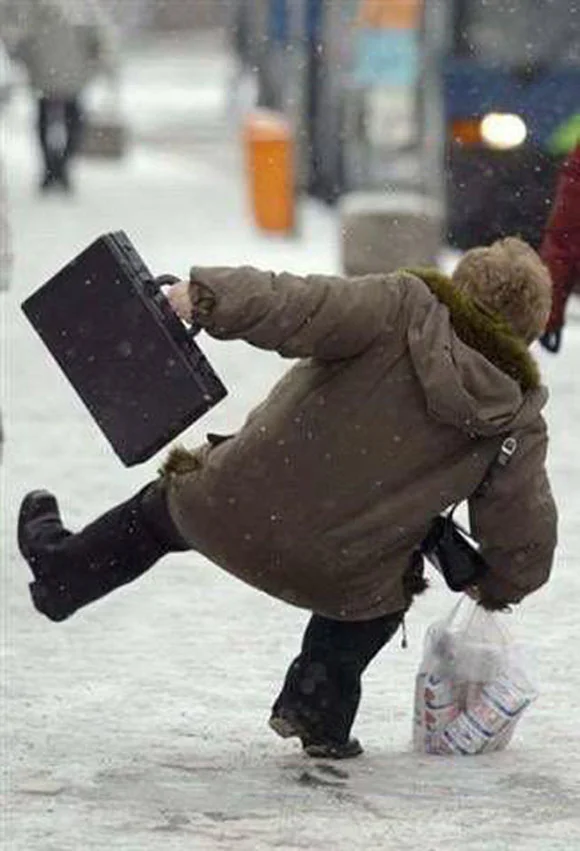
The Broken Ankle v. The Icy Sidewalk
For my attorney colleagues. Or for individuals who felt like they didn't get enough details in the previous post that touched on property owners' obligations to shovel sidewalks.
For my attorney colleagues. Or for individuals who felt like they didn't get enough details in the previous post that touched on property owners' obligations to shovel sidewalks.

To Shovel The Snow or Not - That is the Question
Here’s what homeowners need to know so they can sleep easy at night without worrying about money-hungry, litigation-happy opportunists who walk around looking for an icy sidewalk to slip across.
Click here to download a one-page homeowner's guide on when the law creates an obligation to get out and start shoveling snow.